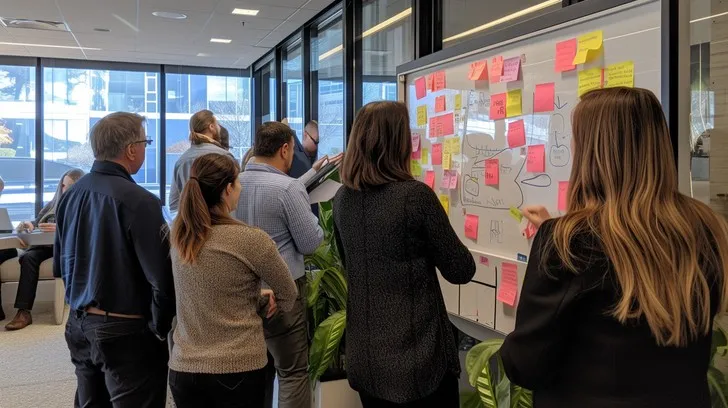
The Sunset Review: Scheduling the Death of Your Weakest Digital Products Before the Market Does
Photo: Alex Chan, CC BY 2.0, via Wikimedia Commons
Every company has a launch ritual. There is a demo, a Slack channel, an internal announcement, and a small celebration. Almost no company has a shutdown ritual, which is why product portfolios accumulate the way garages do: one defensible item at a time, until the space is full and nothing new fits.
The cost is not primarily financial. It is attention. Every marginal offering consumes roadmap review time, security patching, a share of the support queue, and the mental bandwidth of the engineers who still feel responsible for it. None of that appears as a line item, and all of it compounds.
A reverse demo day inverts the ritual. Once a quarter, teams present their weakest offerings for termination rather than their newest for applause. The purpose is not punishment. It is to make the decision to stop an ordinary, scheduled, low-drama event instead of a career risk that nobody volunteers for.
Why nobody schedules a funeral
Shutdowns fail for reasons that are structural, not cultural. The team that built a product is the team least able to evaluate whether it should continue. Sales may still reference it in proposals. A handful of customers depend on it in ways no one has documented. And the person who would have to stand up and say the thing should die has no incentive to do so, because the visible cost of killing it lands on them while the invisible benefit accrues to everyone.
A scheduled review changes the incentive by making the question routine. When every offering is examined on the same cadence, proposing a sunset is no longer an accusation. It is participation.
The format: one afternoon, four quarters
The session should be short, standing, and unrecorded. Two hours is enough. Longer sessions invite filibusters from the offerings with the most sentimental defenders.
| Segment | Duration | Output |
|---|---|---|
| Portfolio readout | 20 minutes | Every offering, one line each: revenue, active accounts, support load, engineering hours |
| Team presentations | 45 minutes | Each nominee argued for by its own team, with a recommendation |
| Adversarial questions | 30 minutes | Three fixed questions asked of every nominee |
| Decision and disposition | 25 minutes | Sunset, invest, merge, or hold — with a named owner and date |
The detail that makes this work is the second row. The team that built the offering presents the case for ending it. That single inversion removes the defensiveness that poisons most portfolio reviews, because the people with the deepest knowledge are using it in the direction the process requires.
The three fixed questions should be identical every quarter, so the answers become comparable over time:
- If this offering vanished tomorrow, which named customers would notice, and what would they do?
- What would we stop doing if we shut it down, and who would absorb that work?
- If we had to build it again today with the same resources, would we?
Sunset criteria that survive contact with reality
Criteria written in the abstract become arguments. Criteria written as thresholds become decisions. Publish them, apply them, and revise them only between cycles.
- Revenue floor. Below a defined annual figure for three consecutive quarters, with no contracted pipeline above it.
- Adoption decay. Active usage declining for four quarters while support tickets hold steady — a reliable signature of a product people pay for but no longer use.
- Substitution. A newer offering inside the portfolio now serves the same job, and the overlap exceeds a stated share of accounts.
- Cost per retained account. Engineering and infrastructure cost divided by retained accounts, trending above the portfolio median for two cycles.
- Single-customer dependency. More than a defined share of revenue from one account, with no path to broadening.
Any one threshold is a trigger for review, not an automatic death sentence. Two together are usually decisive.
Sunk-cost safeguards
The most common objection is that we have invested too much to stop now. The ritual needs an answer prepared before the meeting, not during it.
First, the readout presents forward cost, not historical investment. What has already been spent is a fact about the past and an argument about nothing. Second, every nominee gets a designated advocate from outside its own team — someone whose job is to make the strongest possible case for continuation, so that a sunset decision is never the product of an uncontested conversation. Third, the disposition must be one of four explicit outcomes. Hold is a legitimate answer, but it expires at the next cycle and cannot be renewed by silence.
The talent plan is the whole point
A sunset review without a reallocation plan is a layoff with extra steps, and teams learn quickly to game it. The credible version names where the people go before the decision is announced.
Practically, that means the review produces two documents, not one: a disposition memo and a staffing map. Every engineer, designer, and support specialist attached to a sunset offering should appear on the map with a destination, a start date, and a manager. Where the destination is another team, that team's lead should have agreed to it in advance. Where the answer is genuinely nothing, the honest version of the conversation belongs in a separate forum, handled with care, not smuggled into a portfolio exercise.
What changes after four cycles
The first session is awkward and produces one or two obvious closures. The second is better. By the fourth, three things tend to be true: the portfolio is smaller, the roadmap review is shorter, and teams begin proposing sunsets voluntarily because they have seen what happens to the people involved — which is that they move to something with a future.
That is the innovation advantage. Capacity for new work is not created by hiring alone. It is created by being willing to stop, on a schedule, in public, with a plan for the people who did the work. Companies that build the ritual will find the next launch easier to staff. Companies that do not will keep adding to a portfolio they cannot afford to run and cannot bring themselves to end.